
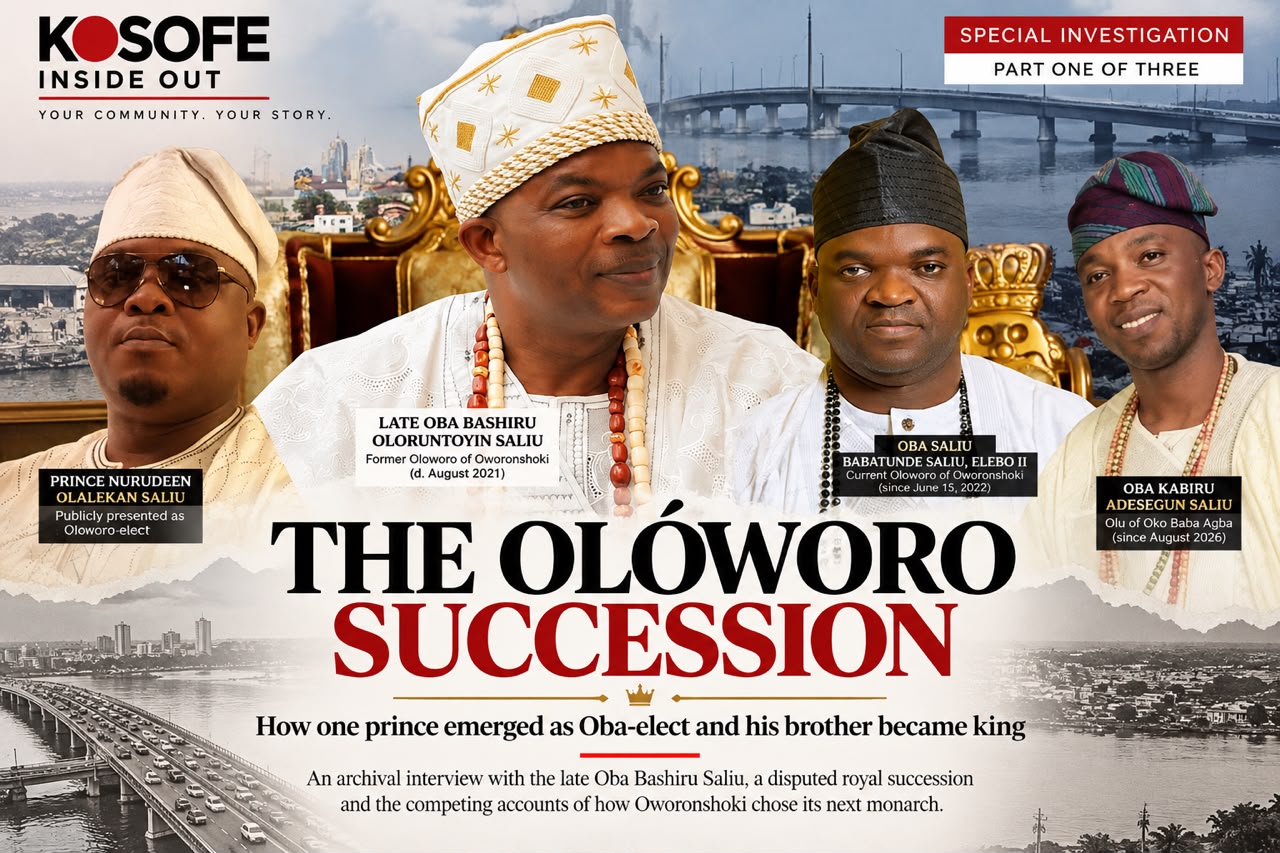
Two decades after Oba Bashiru Saliu fought to secure his throne, his death reopened questions about who should occupy it. Drawing on its exclusive interviews with the late monarch and his successor, Kosofe Inside Out reconstructs the dispute that divided opinion in Oworonshoki and set the stage for a second royal crown.
In October 2021, barely two months after the death of Oba Bashiru Oloruntoyin Saliu, the Osolo of Isolo publicly reaffirmed his support for Prince Nurudeen Olalekan Saliu as the next Oloworo of Oworonshoki.
Oba Kabiru Agbabiaka, a prominent traditional figure associated with the succession process, maintained that Nurudeen had been chosen following consultations involving members of the royal family.
He urged the Lagos State Government to approve the nomination.
Eight months later, however, the government’s Staff of Office went to another son of the late monarch, Prince Saliu Babatunde Saliu.
On June 15, 2022, Babatunde became the government-recognised Oloworo.
The two developments exposed competing accounts of how the throne was to be filled: one advanced by those who publicly supported Nurudeen, the other defended by Babatunde, who maintained that he had secured the necessary kingmakers’ support.
But the story did not begin with either prince.
It began decades earlier, with their father, a monarch whose own claim to the Oworonshoki stool had survived a protracted legal challenge.
And it would eventually involve a third brother, whose journey towards a different royal throne would give the family dispute an entirely new dimension.
The Oworonshoki their father described
Oworonshoki occupies a distinctive place in Lagos.
For commuters, it is a gateway between the mainland and the Island, a waterfront community beside the Third Mainland Bridge. For its residents, it is home to generations of families, traders, artisans and workers whose daily lives are shaped by the opportunities and pressures of metropolitan Lagos.
Yet Oworonshoki’s identity reaches beyond its roads, markets and waterfront.
In 2016, Kosofe Inside Out interviewed Oba Bashiru Oloruntoyin Saliu for a feature published under the headline “Oworonshoki Is the New Lagos Mega City.”
The interview, preserved in KIO’s newspaper archive, offers an important account of how the late monarch understood his community, its origins and his responsibilities as king.
He traced Oworonshoki’s settlement history to an ancestor he identified as Salami Asunmojiba, recounting a journey from Ile-Ife through Agboyi before settlement in the area.
He described the indigenous people as Awori and spoke of a community shaped by fishing, farming, hunting and trade.
According to his account, Oworonshoki, a community named after trade, Òwòre ni shoki, meaning, a place where people transact, grew as people arrived to exchange goods, establish livelihoods and settle among its earlier inhabitants.
The narrative reflects the monarch’s account of the community’s oral history. It is not, by itself, a legal determination of ancestral ownership or the boundaries of traditional jurisdiction.
But the interview reveals something about the king’s priorities.
Oba Bashiru wanted Oworonshoki to develop beyond the conditions he saw around him.
He called for better roads, investment, waterfront reclamation and a transformation comparable to the development taking place elsewhere in Lagos.
When asked about celebrating 20 years on the throne, he expressed reluctance to stage an elaborate anniversary while his community still lacked the development he believed it deserved.
It was an unusually revealing response from a traditional ruler: the celebration he wanted most was a better Oworonshoki.
The same interview also documented another defining feature of his reign.
His throne had been contested.
The court battle before the succession battle
Oba Bashiru recalled being crowned on October 14, 1996. His subsequent government recognition came during Asiwaju Bola Ahmed Tinubu’s administration as Lagos State governor.
The distinction matters because coronation and formal government recognition were not necessarily the same event.
The monarch remained on the throne until his death in August 2021, after nearly 25 years.
During that period, members of another family challenged his entitlement to the Oworonshoki stool.
The dispute reached the Court of Appeal in Ajisegiri v. Salami, appeal number CA/L/132/2014.
On March 10, 2016, the appellate court dismissed the challenge brought by representatives of the Oworonshoki family.
The judges upheld the application of the legal principle preventing parties and those bound by an earlier judgment from reopening matters already conclusively determined.
The ruling affirmed the dismissal of the challenge to Oba Bashiru’s position and the existing chieftaincy arrangements at issue.
It was a significant legal victory for the reigning monarch.
But it did not determine which of his sons should succeed him after his death.
That question would arise five years later, in a different political and family environment.
October 2021: Nurudeen emerges
Following Oba Bashiru’s death, Prince Nurudeen Olalekan Saliu emerged as a leading claimant to the vacant stool.
On October 23, 2021, it was all over social media that Oba Kabiru Agbabiaka, the then Osolo of Isolo, had reaffirmed Nurudeen’s emergence as Oloworo-elect.
Agbabiaka rejected suggestions that he had withdrawn his support and maintained that the selection followed consultations involving members of the family.
His intervention was significant.
It placed a prominent traditional ruler publicly behind Nurudeen’s claim and challenged any impression that the prince’s emergence was merely an informal expression of support by a few relatives.
Other traditional figures also publicly defended Nurudeen’s position, including those who maintained that the late monarch had favoured him.
But the claims raised an essential question.
Had Nurudeen’s endorsement completed the process required under the applicable chieftaincy arrangements, or was further selection and government approval still necessary?
The answer was contested.
And before it could be resolved in the public mind, the dispute had entered the courts.
February 2022: The dispute reaches the High Court
By February 24, 2022, the succession controversy was the subject of proceedings before the Lagos State High Court in Ikeja.
A report published that day identified suit number ID/5224GCM/2021, involving members of the Ajisegiri family, Nurudeen and government defendants.
The court reportedly adjourned proceedings until April 5.
The litigation demonstrated that the disagreement extended beyond the competing ambitions of the late monarch’s sons. Other interests were also questioning the legal basis of claims to the stool.
The existence of the proceedings is documented, but the February report does not establish their final outcome.
Nor should the litigation be confused with the Court of Appeal judgment delivered in 2016, which concerned an earlier challenge during Oba Bashiru’s lifetime.
Both cases form part of Oworonshoki’s chieftaincy history, but they arose at different times and involved distinct legal questions.
May 2022: A royal delegation, and an overlooked detail
In May 2022, with the succession still unresolved, members of the Elebo royal family visited the Ooni of Ife, Oba Adeyeye Enitan Ogunwusi.
Contemporary reporting identified Nurudeen among those in the delegation.
It also named another prince: Kabiru Saliu.
At the time, Kabiru was not the Olu Oko Baba Agba. His name appeared among members of the royal family participating in a visit during the continuing Oloworo controversy.
The purpose of the visit was not publicly established in the report, and it would be speculative to claim that the meeting determined the succession or laid the groundwork for another throne.
Nevertheless, the detail has acquired significance with the passage of time.
Four years later, Kabiru would become a government-recognised traditional ruler in his own right.
The May 2022 record places him within the royal family’s public activities at a critical point in the earlier succession dispute.
It is one of the connections that makes the story of Oworonshoki’s two crowns more complex than a simple disagreement between two brothers.
June 15, 2022: Babatunde receives the Staff of Office
The decisive public development came on June 15, 2022.
Lagos State presented the Staff of Office and appointment letter to Oba Saliu Babatunde Saliu, Elebo II, as the Oloworo of Oworonshoki.
Babatunde, a former Vice-Chairman of Kosofe Local Government, had emerged as the government-recognised monarch.
For supporters of Nurudeen, who had seen their candidate publicly endorsed months earlier, the outcome left questions about how the competing claims had been assessed.
For Babatunde, his installation was the result of a selection process he maintained was legitimate.
The competing positions could not both be fully explained by public endorsements and ceremony photographs.
They required an account of what happened within the traditional selection process.
In July 2022, Kosofe Inside Out obtained one directly from the newly installed monarch.
Babatunde’s account: Four kingmakers backed me
In KIO’s July 2022 interview, published under the headline “I’m the Chosen Oloworo of Oworo,” Oba Babatunde defended his emergence.
He rejected suggestions that he had improperly installed himself.
His explanation centred on the kingmakers.
According to Babatunde, Oworonshoki had seven kingmakers. He said four supported his candidacy, two supported another contender and one remained neutral.
He also maintained that the applicable ruling-house arrangement supported his eligibility.
The account provided an explanation for his emergence that differed fundamentally from the public narrative surrounding Nurudeen’s earlier endorsement.
One side pointed to the selection it said had taken place within the royal family and the support of influential traditional figures.
The other pointed to the kingmakers’ decision and the government’s eventual recognition.
Babatunde’s figures are important because they are specific and capable of being checked against the relevant selection records.
However, the interview alone does not establish the contents of signed kingmakers’ proceedings or the full basis of the government’s approval.
For an independent reconstruction, those records remain essential.
The distinction does not diminish the value of KIO’s interview. It identifies precisely what the monarch asserted and what documentary evidence would be needed to corroborate his account.
By September 2022, Babatunde’s public coronation had taken place, attended by the Ooni of Ife and other dignitaries.
The new Oloworo spoke of peace, development and the need to improve Oworonshoki.
It was an ambition strikingly familiar to anyone who had read his father’s 2016 interview.
Both monarchs spoke about the community’s potential.
Yet the circumstances surrounding the transfer of the crown remained a matter of public interest.
The question KIO’s 2016 archive cannot answer
The late Oba Bashiru’s interview is an important piece of this investigation, not because it names a successor, but because it provides his own account of the institution his sons would later seek to lead.
Incase you missed Oba Bashiru Oloruntoyin Saliu’s interview , read here:
https://drive.google.com/file/d/1N4M43YWrWfCg14MvY24u9WG_0pYo-31q/view?usp=sharing
In the 2016 interview pages examined by KIO, he did not expressly identify Nurudeen, Babatunde or any other son as his preferred successor.
Those who maintain that the late monarch favoured Nurudeen may have their own evidence or recollections. Their assertions should be considered on their merits.
But KIO cannot attribute such a declaration to an archival interview in which it does not appear.
Equally, Babatunde’s description of the kingmakers’ votes must be distinguished from the official proceedings that would independently establish the selection.
The available record establishes a sequence of events: Nurudeen’s public endorsement, a contested legal process, Babatunde’s official recognition and his subsequent explanation of how he emerged.
It does not, without the complete selection and government records, conclusively reconcile the competing accounts.
For Oworonshoki residents, the question is not merely which prince attracted more public support.
It is how the legally recognised selection process was conducted, and how Lagos State arrived at the decision to recognise Babatunde.
That is the issue at the heart of the first crown.
One family, and the story that did not end in 2022
The June 2022 installation settled who the Lagos State Government recognised as Oloworo.
It did not erase the controversy that preceded it.
Nor did it mark the end of the royal family’s changing position within Oworonshoki’s traditional institutions.
On August 14, 2026, Lagos State presented another Staff of Office.
This time, the recipient was Oba Kabiru Adesegun Saliu, a son of the late Oba Bashiru and a brother of the reigning Oloworo.
His title was different.
He was recognised as the Olu Oko Baba Agba.
The prince whose name had appeared in reports of the royal family’s activities during the 2022 succession controversy now occupied a throne of his own.
Two sons of Oba Bashiru had become government-recognised monarchs.
A third brother, Nurudeen, had earlier been publicly championed for the Oloworo stool.
The story had moved beyond succession.
The next question was how another traditional stool came to be recognised in the Oworonshoki axis, and what its emergence meant for a community whose traditional history had already produced years of litigation and competing claims.
That question leads directly to the second part of this investigation.
COMING IN PART TWO
A Second Crown, Five Years in the Making: The Road to Oko Baba Agba
How did Prince Kabiru Saliu move from the royal family’s 2021–2022 succession period to becoming the Olu Oko Baba Agba in August 2026?
KIO examines the reported tribunal recommendation, the path to government recognition and the questions raised by the emergence of another royal stool.
KOSOFE INSIDE OUT
Keeping you informed…