
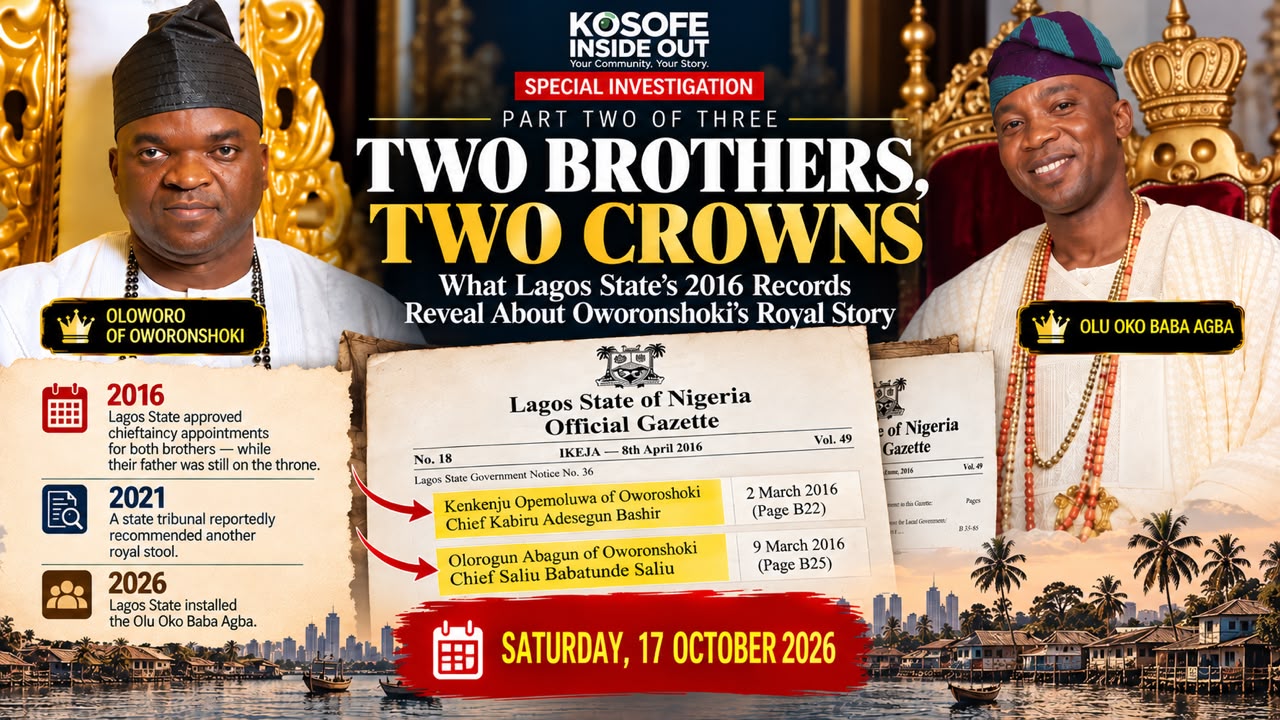
Ten years before two sons of the late Oloworo emerged as government-recognised monarchs, Lagos State had already approved separate chieftaincy appointments for both men. KIO examines the official records, a reported 2021 tribunal recommendation and the recognition that followed in 2026.
When Oba Kabiru Adesegun Saliu received his Staff of Office as the Olu Oko Baba Agba on August 14, 2026, the ceremony marked an unusual development in Oworonshoki’s traditional history.
Another son of the late Oba Bashiru Oloruntoyin Saliu had become a government-recognised monarch.
His brother, Oba Saliu Babatunde Saliu, had occupied the Oloworo throne since June 2022.
For a community that had witnessed competing claims following their father’s death, the emergence of two monarchs from the same royal family raised questions about succession, traditional authority and the historical identity Oko Baba Agba.
But documents examined by Kosofe Inside Out reveal that the brothers’ separate paths through Lagos State’s recognised chieftaincy system began much earlier than the public controversies of recent years.
In March 2016, more than five years before their father’s death, the Lagos State Executive Council approved traditional chieftaincy appointments for both men.
Their names appeared in the same edition of the Lagos State Official Gazette, published on April 8, 2016.
One would eventually become Oloworo.
The other would receive a separate royal crown.
Between those developments lay a reported tribunal recommendation, a prolonged campaign for government approval and an unresolved question about the relationship between the two traditional institutions.
The 2016 gazette: Two appointments, one royal family
The first documentary evidence appears in Lagos State Official Gazette No. 18, Volume 49, dated April 8, 2016.
The publication records appointments approved under Section 22 of the Obas and Chiefs Law, Cap. 02, Laws of Lagos State of Nigeria, 2003.
On page B22, the gazette records that the State Executive Council, at its 17th meeting held on March 2, 2016, approved Chief Kabiru Adesegun Bashir as Kenkenju Opemoluwa of Oworoshoki, using the spelling contained in the government document.
His appointment was listed under Kosofe Local Government Area.
A week later, at its 18th meeting on March 9, the council approved Chief Saliu Babatunde Saliu as Olorogun Abagun of Oworonshoki.
That appointment appears on printed page B25 of the same gazette.
Both notices were made at Ikeja on April 5, 2016, under the administration of Governor Akinwunmi Ambode.
The significance of these entries is not simply that both men possessed traditional titles.
Their appointments were formally approved by the Lagos State Government and recorded in an official publication while their father was still the reigning Oloworo.
At the time, Oba Bashiru had occupied the throne for nearly two decades.
The gazette therefore establishes that Kabiru and Babatunde were already separately recognised within Oworonshoki’s chieftaincy structure long before either became a monarch.
It does not, however, identify either brother as heir to the Oloworo throne.
Nor does Kabiru’s 2016 appointment establish that Oko Baba Agba was already recognised as a separate kingdom.
His recorded chieftaincy title was expressly associated with Oworonshoki.
That distinction becomes important when the story moves forward five years.
2021: A royal succession and another traditional claim
Oba Bashiru died on August 30, 2021, bringing an end to a reign that began in October 1996.
His death reopened the question of succession to the Oloworo throne.
As Part One of this investigation examined, Prince Nurudeen Olalekan Saliu was publicly championed by supporters as a candidate for the throne.
Babatunde subsequently emerged as the government-recognised Oloworo, receiving his Staff of Office on June 15, 2022.
But another development was reportedly unfolding within the state chieftaincy system.
According to reports published in August 2023 by P.M. News and other newspapers, the Lagos State Standing Tribunal of Inquiry into Chieftaincy Matters had recommended, on November 9, 2021, the elevation of Kabiru to a second-class traditional stool bearing the title Olu Oko Baba Agba.
The reported recommendation came less than three months after their father’s death.
It also preceded Babatunde’s formal installation as Oloworo.
The timing places the two processes within the same period of uncertainty over Oworonshoki’s traditional leadership.
But timing alone cannot establish a connection between them.
There is no verified documentary evidence that Kabiru’s proposed elevation was compensation for the Oloworo succession, part of an agreement between the brothers or a government arrangement to divide the traditional authority of Oworonshoki.
The records available to KIO establish parallel developments involving members of the same royal family.
They do not establish that one process caused the other.
The tribunal report that could explain the decision
The reported November 2021 recommendation is a critical stage in the history of the Olu Oko Baba Agba stool.
Contemporary accounts identified retired Justice Titilola Ojikutu-Oshode as chairperson of the tribunal that considered the matter.
The tribunal’s functions, as described by the Lagos State Ministry of Justice, include investigating historical chieftaincy claims, the ancestry of ruling houses, traditional succession and proposals to elevate existing chiefs to royal status.
Such inquiries are intended to provide the government with findings and recommendations before a decision is made.
An image circulating on social media shows what appears to be the cover of a Lagos State tribunal report specifically concerning the Olu Oko Baba Agba in Kosofe Local Government Area.
The document is titled Report of the Standing Tribunal of Inquiry into Chieftaincy Matters in Lagos State in Respect of Olu Oko Baba Agba.
The image establishes that a document bearing that title has been publicly displayed.
But the complete report has not been independently examined by KIO.
Its date, originating application, evidence, objections, findings and signed recommendations have therefore not been verified from the original text.
This limits what can responsibly be concluded about the process.
For example, the published accounts do not establish when Kabiru’s application was first submitted.
That date matters.
If the process began before Oba Bashiru’s death, it would provide a different historical context from an application initiated during the succession dispute.
Neither possibility can be presented as fact without the relevant record.
The report would also help answer another important question: what historical or customary basis did the tribunal accept for recognising Oko Baba Agba as a separate traditional institution?
What the 2016 records do—and do not—prove
The April 2016 gazette introduces a distinction that has received insufficient attention in public discussion.
Kabiru was recognised in that document as a chief of Oworonshoki.
Five years later, a tribunal reportedly recommended his elevation to the Olu Oko Baba Agba stool.
The two developments concern different titles.
The first is directly documented by the gazette.
The second is supported by contemporary reporting of the tribunal’s recommendation, pending examination of the original report.
The gazette does not explain whether Oko Baba Agba was considered an established settlement with its own customary leadership, a traditional institution seeking elevation or a community whose royal status required formal recognition.
Those are matters for the tribunal’s findings and subsequent government approval documents.
The 2016 records are therefore significant evidence of the brothers’ earlier chieftaincy status, but not conclusive evidence of the historical or geographical status of Oko Baba Agba.
Another 2016 government document
A second official publication examined by KIO provides additional context about Lagos State’s chieftaincy administration.
Lagos State Official Gazette No. 23, dated June 6, 2016, contains the state’s revised administrative guidelines for local governments and local council development areas.
Section 6.6 addresses local government chieftaincy committees.
The guidelines describe responsibilities relating to the creation, filling and upgrading of traditional stools, as well as the consideration of chieftaincy matters and recommendations to government.
This demonstrates that the state’s published administrative framework recognised formal procedures for handling chieftaincy questions.
It does not establish which procedures were followed in the Oko Baba Agba case.
Nor does it establish that any particular committee approved or opposed Kabiru’s eventual elevation.
The document is useful as evidence of the administrative framework in place during the period, not as proof of the outcome of an inquiry conducted years later.
2023: The crown was still awaiting approval
By August 2023, nearly two years after the reported tribunal recommendation, Chief Kabiru had not been formally installed as Olu Oko Baba Agba.
Supporters of the proposed stool publicly appealed to Governor Babajide Sanwo-Olu to approve the appointment.
Chief Nasiru Salami, identified in contemporary reporting as chairman of the Olu Oko Baba Agba Royal Family, said the tribunal had returned a favourable recommendation.
He also claimed that recommendations from the relevant consenting authorities had been obtained.
Those statements are important because they suggest that proponents believed the necessary stages of the recognition process had substantially progressed.
But the actual consent documents were not reproduced in the published reports examined for this investigation.
Their dates, signatories, conditions and precise recommendations remain unverified.
The distinction between a tribunal recommendation, the consent of relevant traditional authorities and final government recognition is important.
A recommendation is not itself the presentation of a Staff of Office.
Nor does a public claim that consents have been obtained establish the contents of those documents.
What is clear is that supporters were still seeking final approval in 2023.
The reasons for the interval between the reported 2021 recommendation and the eventual 2026 installation have not been conclusively established.
The historical case advanced by Oko Baba Agba
The campaign for recognition was presented by its supporters as a matter of community identity, not merely the elevation of an individual chief.
Chief Ayinde Sulaiman, identified as the Bobaselu of Oko Baba Agba, described the area in 2023 as a historic riverine settlement associated with the community’s forebears.
Supporters argued that a recognised traditional ruler would strengthen representation, encourage development and support community security.
These statements provide insight into the historical and social arguments advanced for the proposed stool.
They do not independently establish its boundaries or determine how its traditional jurisdiction relates to that of the Oloworo.
Those questions require examination of historical evidence, official recognition documents and any relevant legal determinations.
2026: Lagos State recognises the second crown
On August 14, 2026, Lagos State formally installed Kabiru as Olu Oko Baba Agba at the Kosofe Local Government Secretariat.
Governor Sanwo-Olu was represented by his Special Adviser on Rural Development, Dr Nurudeen Yekinni Agbaje.
The ceremony included the presentation of a Staff of Office and Instrument of Appointment.
It brought to a conclusion the publicly documented campaign for Kabiru’s formal recognition.
For the royal family, it also meant that two sons of the late Oba Bashiru now occupied government-recognised royal stools.
Babatunde remained Oloworo of Oworonshoki.
Kabiru had become Olu Oko Baba Agba.
Yet the installation left an important issue unresolved in the publicly accessible records examined by KIO.
The objections from the Oloworo’s side
The emergence of the second stool was not without controversy.
Babatunde was reportedly absent from his brother’s installation, although the reason for his absence has not been independently established.
Subsequent local reporting quoted an unnamed source described as being within the Oloworo’s palace, questioning the existence of a separate Oko Baba Agba traditional community within the area claimed by Oworonshoki.
The source also suggested that legal action was being considered.
Those assertions require careful treatment.
An anonymous palace source cannot automatically be presented as speaking officially for the Oloworo.
Likewise, an expressed intention to challenge an appointment does not establish that a case has been filed or that a court has ruled on the matter.
Nevertheless, the reported objection raises a substantive historical question.
If supporters of Oko Baba Agba maintain that the community possesses a distinct traditional identity, and opponents dispute that identity, the disagreement cannot be resolved solely by reference to the relationship between the two monarchs.
It requires evidence about the community, the traditional institutions involved and the terms of the government’s recognition.
What the late Oloworo told KIO
There is another historical record worth revisiting.
In 2016, the same year Lagos State approved the brothers’ separate chieftaincy appointments, their father spoke extensively to Kosofe Inside Out about Oworonshoki.
The interview, published under the headline “Oworonshoki Is the New Lagos Mega City,” recorded Oba Bashiru’s account of the community’s origins, its Awori heritage and its traditional leadership.
He traced the community’s ancestry through a forebear he identified as Salami Asunmojiba and discussed historical connections with Ile-Ife and Agboyi.
The late monarch also addressed land, development and disputes that had shaped his reign.
His account remains an important part of KIO’s historical archive.
But the interview was not a legal determination of the boundaries of Oworonshoki or Oko Baba Agba.
It cannot be used to establish that a separate stool is valid or invalid.
Its relevance is that it preserves the late monarch’s account of the community whose traditional leadership is now the subject of renewed public interest.
What ten years of documents establish
Taken together, the records reveal three significant stages.
First, the 2016 appointments.
The Lagos State Government formally approved Kabiru as Kenkenju Opemoluwa of Oworoshoki and Babatunde as Olorogun Abagun of Oworonshoki while their father remained Oloworo.
These appointments are documented in the April 2016 Official Gazette.
Second, the reported 2021 recommendation.
Contemporary news reports state that a Lagos State chieftaincy tribunal recommended Kabiru’s elevation to the Olu Oko Baba Agba stool in November 2021.
The complete report remains outstanding, so its findings cannot yet be independently attributed to the tribunal.
Third, the 2026 recognition.
Lagos State formally installed Kabiru as Olu Oko Baba Agba, completing a recognition process that supporters had publicly pursued for years.
These stages establish a longer history of official chieftaincy recognition than the recent controversy alone suggests.
But they do not establish that the government deliberately divided Oworonshoki between the brothers.
They do not establish that the second crown was created to resolve the Oloworo succession.
And they do not conclusively define the traditional jurisdiction attached to Oko Baba Agba.
Those are separate questions requiring their own evidence.
Two brothers, two crowns—and one question that remains
The story that began with two government-approved chieftaincy appointments in March 2016 has developed into one of the most consequential traditional leadership questions in Oworonshoki.
The brothers’ earlier titles were recorded in the same Lagos State gazette.
Their subsequent paths led to different royal stools.
The evidence establishes the appointments, the reported tribunal recommendation and the eventual government recognition.
What it does not yet establish is the precise historical and jurisdictional relationship between the two institutions.
For residents, that distinction matters.
Traditional rulers play important roles in cultural identity, customary representation and community affairs. Understanding which traditional institutions have been recognised, and on what basis, is a legitimate matter of public interest.
Such recognition should not be confused with automatic ownership of land or statutory control over planning and local government administration.
But the traditional jurisdiction associated with a recognised stool remains a question deserving documentary clarity.
Ten years ago, the Lagos State Government approved two brothers as chiefs of Oworonshoki.
Today, both are monarchs.
The documents explain how their separate paths began. The question now is where their recognised traditional jurisdictions meet—and whether they overlap.
COMING IN PART THREE
Two Thrones, One Boundary Question: Who Has Authority Where in Oworonshoki?
In the concluding instalment, KIO examines the historical claims surrounding Oworonshoki and Oko Baba Agba, the meaning of traditional jurisdiction and the government records needed to clarify the relationship between the two royal stools.
KOSOFE INSIDE OUT
Your Community. Your Story.