
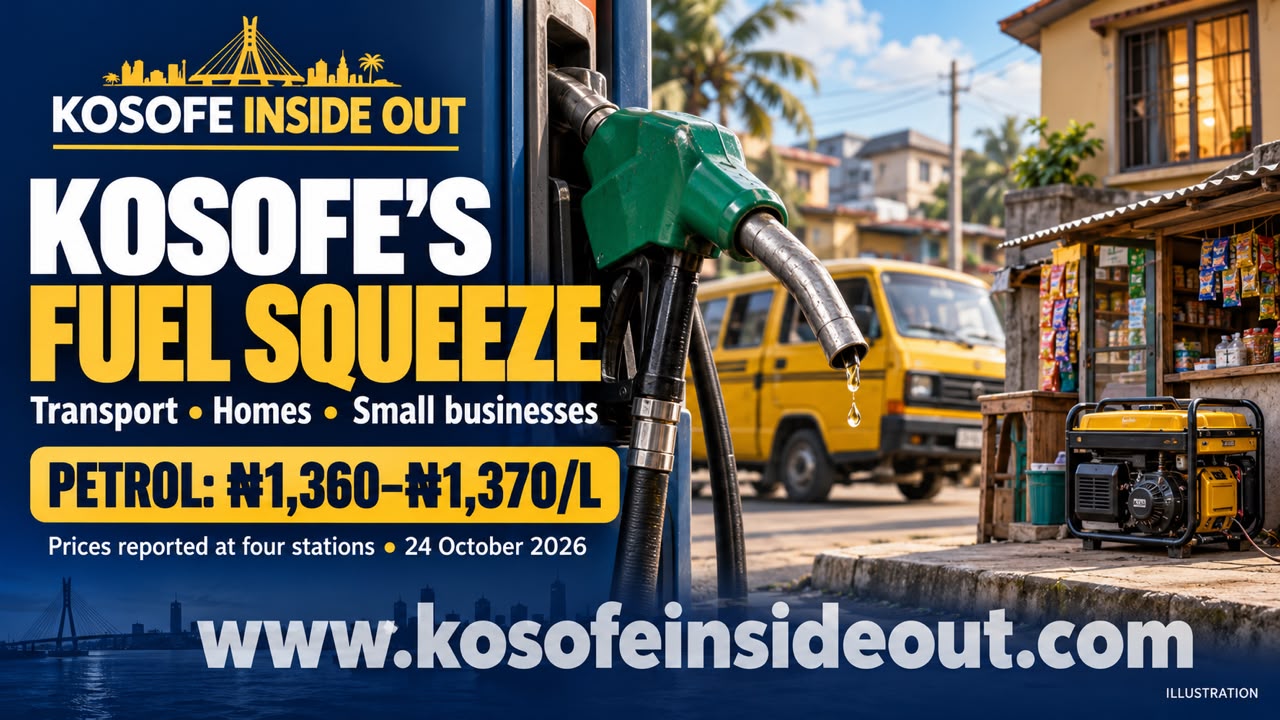
The same Kosofe household can face fuel costs three ways: through the journey to work, the generator powering the home and the expense of keeping a small business open.
Price checks supplied to Kosofe Inside Out on October 24 put petrol at ₦1,360–₦1,370 per litre across four filling stations serving the area. At those rates, 20 litres cost ₦27,200–₦27,400—almost two-fifths of Nigeria’s ₦70,000 national minimum wage.
Electricity interruptions deepen that exposure. Where residents and businesses depend on petrol generators during outages, fuel spending becomes part of the cost of maintaining daily life and earning an income.
Prices reported at the stations
| Filling station | Petrol per litre | Diesel per litre |
| NNPC, Tipper Garage | ₦1,360 | ₦1,860 |
| MRS, Ojota bus stop | ₦1,360 | ₦1,862 |
| Total, Ikosi Road | ₦1,370 | ₦1,870 |
| Con Oil, Tollgate, Lagos–Ibadan Expressway | ₦1,370 | ₦1,870 |
Prices reported on October 24, 2026. The checks cover these four outlets, rather than every filling station in Kosofe.
The ₦10-per-litre difference between the cheapest and most expensive petrol in the sample saves a customer ₦200 on 20 litres, before any additional expense of travelling to the cheaper outlet.
The journey to work
Nigeria’s national minimum wage remains ₦70,000. Lagos State has implemented an ₦85,000 minimum for its public servants; neither figure represents what every Kosofe resident earns.
For commuters travelling through Ketu, Mile 12, Ojota and Alapere, the immediate concern is how much reaching work takes from their earnings.
Illustrative commuter budget: A worker spending ₦2,000 daily on return journeys would pay ₦44,000 over 22 working days. That would absorb almost 63 per cent of a ₦70,000 salary, leaving ₦26,000 for other expenses.
Every additional ₦100 in each direction would add ₦4,400 to that monthly bill.
Keeping the lights on at home
Households buying petrol for generators face another demand on the same income.
Illustrative household fuel purchase: Ten litres would cost ₦13,600–₦13,700 at the reported prices—almost one-fifth of a ₦70,000 monthly wage.
How long that purchase lasts depends on the generator, the appliances it powers and the hours of use. It is not a measured household consumption figure.
For families paying both commuting and generator bills, the expenses accumulate alongside food, rent, school costs and healthcare.
When electricity fails, businesses buy fuel
Oworonshoki provides a local example of frustration over electricity supply.
Kosofe Post reported on October 21 that residents were organising a fresh protest over persistent outages and what organisers described as an unfulfilled commitment to provide at least 16 hours of electricity daily. The report referred to an earlier protest and said another demonstration was scheduled for October 22. It did not establish whether that planned demonstration subsequently took place.
The report did not include a response from the electricity authorities to the organisers’ latest complaints. The claimed supply commitment therefore remains attributed to the organisers.
For a barber, salon or printer relying on a petrol generator during supply interruptions, the pump price becomes part of the cost of each operating hour. The alternative may be to suspend services until electricity returns.
Illustrative business fuel budget: A business buying 20 litres weekly would spend ₦108,800–₦109,600 over four weeks at the reported prices, before rent, wages, stock and other expenses. This is a calculation, not a surveyed business’s spending.
Actual consumption varies by equipment, electricity supply and operating hours. Where fuel expenses rise, owners face a choice between accepting lower profit, increasing charges or reducing generator use. Higher charges can also discourage customers whose household budgets are already stretched.
Diesel-dependent households and businesses face a separate bill. Twenty litres at the four stations cost ₦37,200–₦37,400. Petrol and diesel expenses must be assessed separately when examining generator costs and delivery charges.
What relief does the discount offer?
The federal government’s proposed ₦1,350-per-litre benchmark concerns wholesale petrol costs. It is not a guaranteed filling-station price: distribution and retail expenses can take the final pump price higher.
NNPC’s separate ₦66-per-litre discount applies to qualifying purchases through its Fuel App. The company says the initiative runs until October 31 and does not establish a uniform national pump price. On a qualifying 20-litre purchase, the saving would be ₦1,320.
No discount terms were reported during the checks at the four stations. Whether NNPC Tipper Garage’s reported ₦1,360 price already included the offer, or whether qualifying customers could obtain a further reduction, was not established.
For Kosofe residents, relief has two practical tests: a clear price at the pump and less need to buy generator fuel. NNPC should make its discount conditions explicit. Ikeja Electric should explain the supply position in affected Oworonshoki communities and address residents’ complaints about promised service hours.
A fuel discount can reduce the cost of a purchase. Dependable electricity can reduce the need to make that purchase at all.