
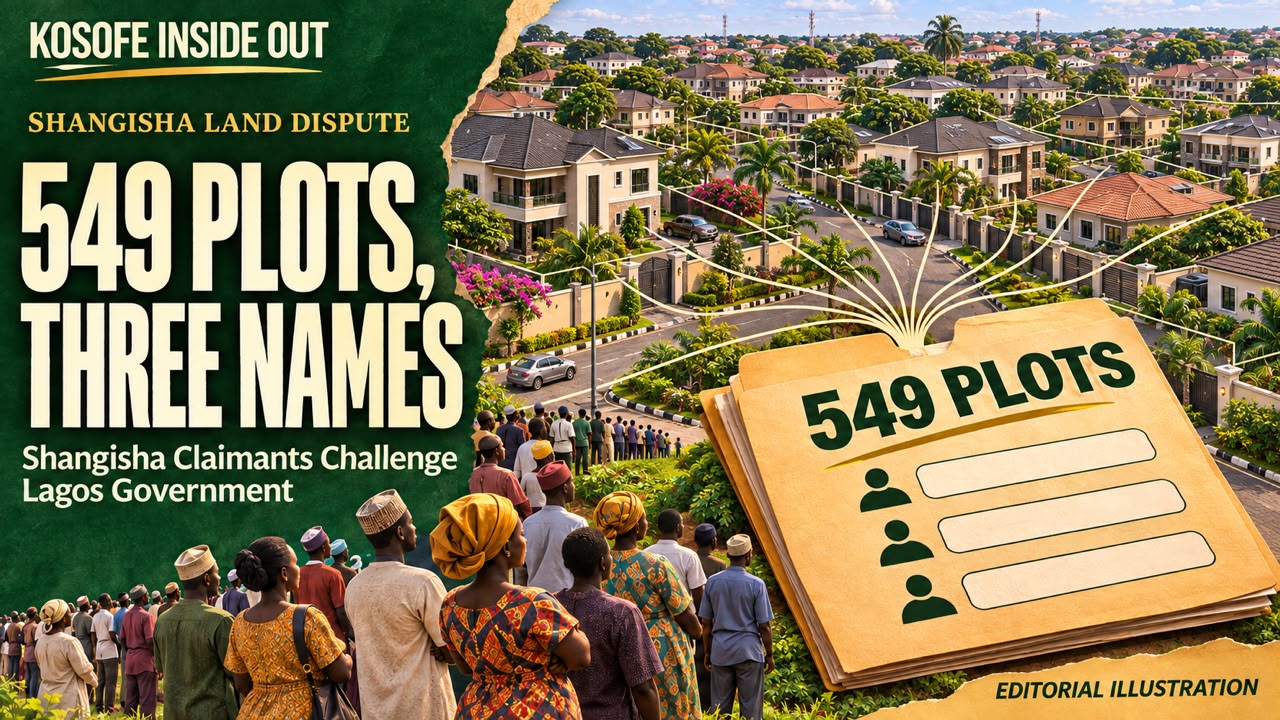
Fourteen years after the Supreme Court upheld an order for 549 plots to be allocated to Shangisha landlords, 546 judgment creditors are questioning an arrangement they allege places the entire allocation under three names.
The claimants accuse the Lagos State Government of issuing a single Certificate of Occupancy covering the plots to Chief Adebayo Adeyiga and two associates. They want the title suspended or revoked, arguing that it could undermine other beneficiaries’ interests while two appeals remain unresolved.
The central question is what the alleged three-name arrangement means for everyone else entitled to an allocation. The available reports do not establish whether the recipients hold the title personally or in a representative capacity, or what provisions protect individual beneficiaries.
According to the complainants’ account, the majority rejected a proposal to place all 549 plots in Adeyiga’s name and those of two associates. They sought separate titles for individual beneficiaries or, alternatively, allocation to the registered trustees of the Shangisha Landlords Association for distribution among legitimate members.
They say they communicated their objections to the Land Use and Allocation Committee and Governor Babajide Sanwo-Olu. Alongside their demand concerning the certificate, they want further administrative dealings suspended until the Court of Appeal determines the outstanding cases.
The disagreement adds another layer to litigation that began after demolitions at Shangisha between June 1984 and May 1985.
The landlords filed their original action on 17 June 1988. On 31 December 1993, the Lagos High Court granted affected association members preferential treatment in land allocation or reallocation and ordered the government to allocate 549 plots in the Shangisha village scheme.
The Court of Appeal upheld the decision on 25 September 2001. The Supreme Court dismissed the government’s further appeal on 10 February 2012, leaving the allocation order standing.
The latest challenge concerns how that order should be implemented and who can act for its beneficiaries.
The first appeal, CA/L/1005M/2018, arose from a ruling reportedly restricting Adeyiga’s representation to six members rather than all 549 judgment creditors.
The second, CA/LAG/CV/117/2026, brought by Mrs Ogunsola Dawodu and others, challenges Justice Lawal Alebiosu’s refusal to order individual allocations or title in the association’s registered trustees’ names. An interlocutory injunction application has also reportedly been filed.
Both appeals are described as pending in the published accounts. KIO has not independently verified their current status or an order granting the injunction application.
The complainants have also questioned the role of Attorney-General and Commissioner for Justice, Lawal Pedro.
According to the published account of his response to a petition before the Legal Practitioners’ Privileges Committee, Pedro stated that administrative action on granting the certificate had been suspended because of litigation. The complainants question how the disputed title could subsequently have been issued.
However, the dates of the suspension instruction and the alleged issuance have not been established in the material reviewed. That prevents a firm conclusion about their sequence or whether the government changed its position.
The reports identify 546 creditors behind the latest complaint, while referring elsewhere to 549 judgment creditors and the court-ordered 549 plots. A beneficiary register explaining those figures was not available for this report.
Nor does the available material identify the disputed plots sufficiently to establish whether existing Magodo homes are affected. The fresh allegation does not, by itself, establish any impending possession or demolition exercise.
KIO has not inspected the disputed certificate or obtained direct responses from the Lagos State Government, Pedro or Adeyiga to the latest allegations. This account draws on published reporting and the historical court judgment.
For beneficiaries still awaiting implementation, the unresolved issue is concrete: how does the alleged single title preserve each person’s entitlement, who controls distribution, and when will i
ndividual allocations be delivered?