
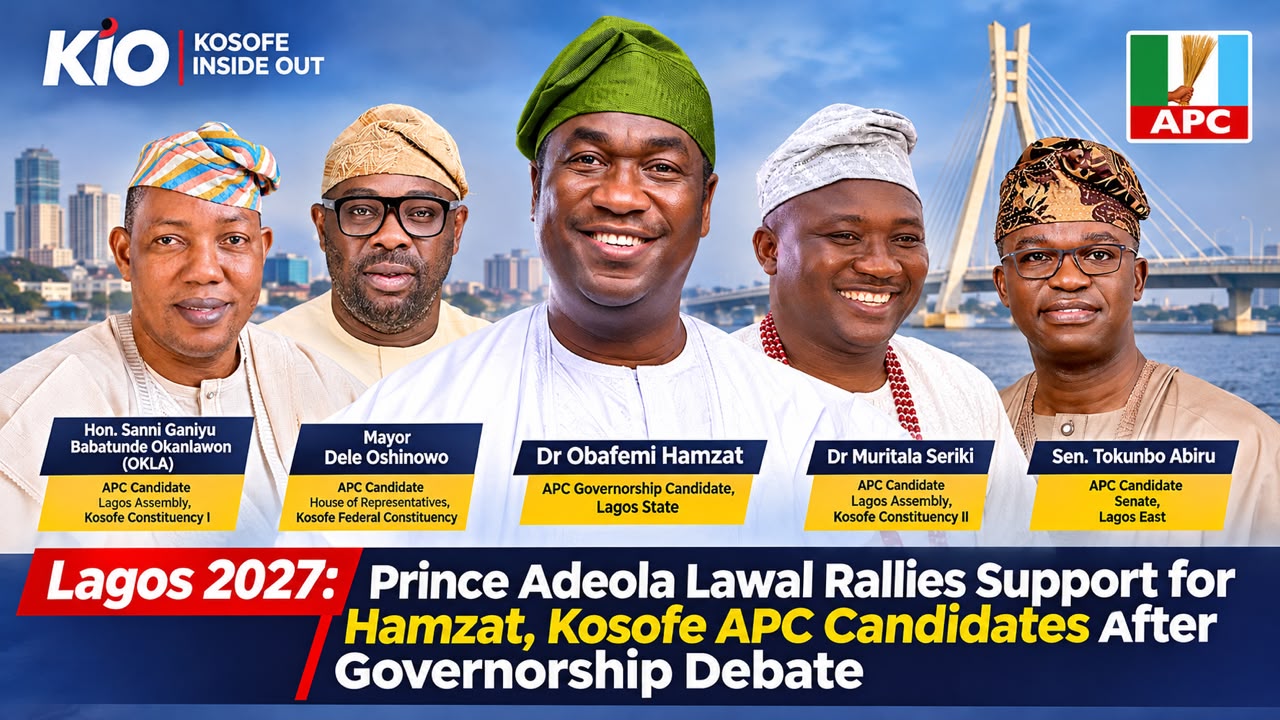
Prince AbdulRafiu Adeola Lawal, a Nigerian-American businessman with political roots in Kosofe, is rallying support for Lagos State Deputy Governor, Dr Obafemi Hamzat, and candidates of the All Progressives Congress (APC) across the constituency ahead of the 2027 general elections.
Lawal, whose political base extends from Ikosi-Isheri to the wider Kosofe constituency, is backing a party ticket that includes candidates for the governorship, National Assembly and Lagos State House of Assembly.
His support comes as Hamzat's performance at the November 8 Lagos governorship debate draws attention to the deputy governor's administrative experience, command of policy issues and proposals for addressing the state's infrastructure and public service challenges.
The debate, organised by the Nigeria Debate Consortium and broadcast on Channels Television, offered voters an opportunity to assess the candidates beyond campaign rallies and political endorsements.
Hamzat's appearance at the televised debate provided a prominent platform to defend his record in government and explain how he intends to address Lagos State's development challenges.
Facing Gbadebo Rhodes-Vivour of the African Democratic Congress, Funso Doherty of the Nigeria Democratic Congress and Deji Doherty of the Peoples Democratic Party, Hamzat drew extensively on his experience in public administration.
On transportation, he outlined plans to introduce 4,000 compressed natural gas buses, with a proposed capacity to move one million passengers daily, alongside 77 electric ferries intended to strengthen water transportation.
He also defended the government's investments in rail infrastructure, arguing that an integrated system connecting roads, railways and waterways would improve mobility across Lagos.
On housing, Hamzat cited the development of 24 housing estates over eight years and proposed expanded mortgage access, completion of ongoing projects and stronger enforcement of regulations against excessive advance rent demands.
The specificity of these proposals gave supporters a basis for presenting Hamzat as a candidate familiar with the workings of government.
However, the debate also brought the administration's record under scrutiny.
Opposition candidates challenged the government over flooding, housing affordability, public expenditure and the rising cost of living.
Hamzat's position as deputy governor placed him in the unusual position of defending existing policies while asking voters to trust him with responsibility for the state's next phase of development.
His performance therefore offered both an advantage and a test: experience could strengthen his candidacy, but it also made the government's record a central issue in the election.
For Lawal, whose political involvement has roots in Ikosi-Isheri, support for Hamzat reflects a wider interest in the direction of governance in Lagos State.
His earlier endorsement of the deputy governor highlighted Hamzat's background in science, technology and public administration, particularly his tenure as Commissioner for Science and Technology.
That experience remains relevant to a governorship contest in which candidates are being challenged to demonstrate how technology, infrastructure investment and effective public administration can improve everyday life.
The constituency occupies an important position within Lagos East, encompassing communities with different economic and infrastructure needs, from the commercial activity around Mile 12 and Ketu to residential neighbourhoods in Ikosi-Isheri, Ogudu, Agboyi and Oworonshoki.
Political mobilisation across these communities will require candidates to address local concerns rather than rely exclusively on party loyalty.
Alongside Hamzat, the APC is seeking victories across the National Assembly and Lagos State House of Assembly contests.
Senator Tokunbo Abiru is seeking another term representing Lagos East in the Senate, while former Agboyi-Ketu LCDA chairman, Mayor Dele Oshinowo, is contesting the Kosofe Federal Constituency seat in the House of Representatives.
Oshinowo's candidacy represents an attempt to move from local government administration to federal legislative representation.
His experience as council chairman has featured prominently in his political profile, although voters will also be assessing his ability to perform the distinct responsibilities of a federal lawmaker, including legislation, oversight and constituency representation.
In the Lagos State House of Assembly contests, Hon. Sanni Ganiyu Babatunde Okanlawon, popularly known as OKLA, is seeking to retain the Kosofe Constituency I seat, while Dr Muritala Seriki is seeking election in Kosofe Constituency II.
Okanlawon's legislative record and constituency interventions are likely to feature in assessments of his candidacy, while Seriki faces the task of demonstrating how he intends to represent communities within his constituency.
Together, the candidates form part of the APC's effort to maintain political influence across Kosofe and strengthen its representation at state and federal levels.
The party's electoral argument rests partly on the benefits of having representatives working within the same political structure.
But coordinated party representation does not automatically guarantee improved governance. The candidates must demonstrate what they intend to achieve individually and how their offices can contribute to development.
For residents of Kosofe, Hamzat's debate proposals are particularly relevant to transport, housing and infrastructure.
Traffic congestion along the Ikorodu Road corridor remains a daily concern for commuters travelling through Ketu, Mile 12, Ojota and Anthony.
An expansion of public transportation could ease pressure on these routes, but the impact would depend on implementation, route coverage, affordability and integration with existing services.
Communities across Kosofe have experienced drainage challenges and disruption during heavy rainfall, raising questions about the adequacy of infrastructure investment and maintenance.
Hamzat's defence of the government's environmental interventions must therefore be assessed against conditions experienced by residents.
Housing affordability presents a similar challenge. Mortgage expansion and new housing developments may increase supply, but their value to ordinary residents will depend on whether lower- and middle-income households can realistically access them.
These are practical tests of the policies Hamzat presented at the debate.
Beyond endorsements, voters will judge delivery
As the 2027 elections approach, political endorsements and grassroots mobilisation are expected to intensify across Kosofe.
Lawal's support for Hamzat and the wider APC ticket forms part of that political activity, but the electoral contest will ultimately turn on how convincingly candidates address residents' concerns.
Hamzat has used the televised debate to present his experience and policy proposals. Oshinowo, Abiru, Okanlawon and Seriki must similarly make the case for their respective legislative ambitions.
For residents from Ikosi-Isheri to Agboyi-Ketu, Oworonshoki, Ogudu and other communities across Kosofe, the central question is not simply which party wins.
It is whether those elected can deliver better roads, more reliable public services, improved economic opportunities and effective representation.
The 2027 elections will provide voters with an opportunity to measure the promises of the candidates against their records and expectations for the future.