
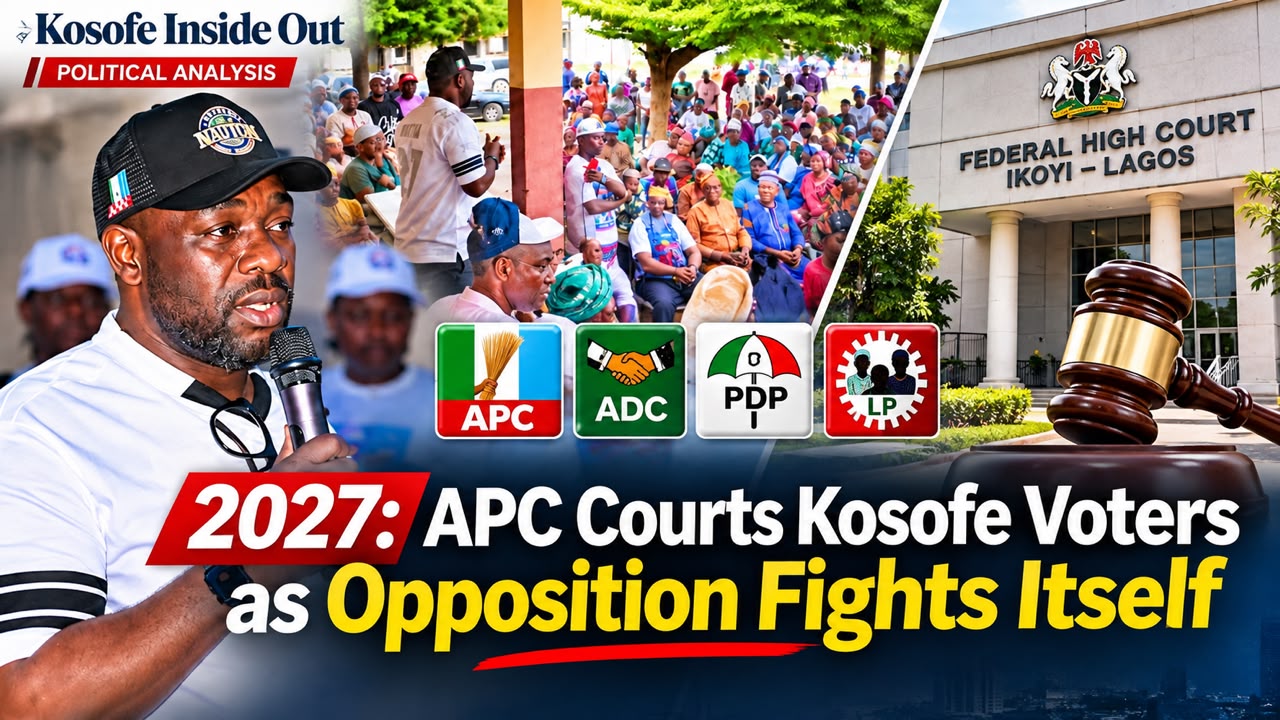
With the ADC's Kosofe House of Representatives ticket tied up in litigation, PDP leadership disputes unresolved and questions surrounding Labour Party's grassroots presence, the APC is pressing ahead with community mobilisation.
While the All Progressives Congress (APC) takes its campaign into Kosofe’s neighbourhoods, two aspirants of the African Democratic Congress (ADC) are battling in court over who should represent the opposition party in the 2027 House of Representatives election.
The dispute between Kayode Ayodeji and Debo Adesina has reached the Federal High Court in Ikoyi, Lagos, where judgment is scheduled for Tuesday, November 17.
The disagreement has also exposed tensions beyond the courtroom. An ADC member has publicly suggested supporting the APC’s House of Representatives candidate, Dele Oshinowo, if the party’s nomination dispute is not resolved in his preferred aspirant’s favour.
It is a striking development in a constituency where opposition parties are attempting to organise against the ruling party.
The Peoples Democratic Party (PDP) continues to face wider leadership uncertainty, while the Labour Party, which attracted substantial electoral support in Kosofe in 2023, has a less clearly documented grassroots campaign presence ahead of 2027.
For residents of Ojota, Ogudu, Ketu, Mile 12, Oworonshoki, Agboyi and Ikosi and Isheri, the emerging political contest raises a practical question: which parties are preparing to represent their communities, and which are still struggling to resolve internal disagreements?
ADC’s Kosofe ticket battle exposes political divisions
The dispute between Ayodeji and Adesina centres on competing claims to the ADC nomination for Kosofe Federal Constituency.
Following proceedings on November 13, Justice Aluko Olukorede of the Federal High Court fixed November 17 for judgment.
The case has become an important test of the party’s ability to resolve internal disagreements before the election.
ADC member Olushola Daniyan publicly questioned Adesina’s candidacy and suggested that dissatisfied members could support candidates from other political parties.
His proposed arrangement included backing Oshinowo of the APC for the House of Representatives while supporting candidates from different parties in other contests.
Daniyan emphasised that the suggestion represented his personal position, not an official decision of the ADC.
The distinction is important. His statement does not establish a party-wide defection or alliance, but it illustrates how disagreements over candidate selection can create competing political loyalties.
Adesina, meanwhile, has continued to outline his constituency agenda, including digital skills training, erosion control, community security and regular town hall meetings.
The ADC therefore faces two immediate challenges: resolving the nomination dispute and maintaining cooperation among its members after the court’s decision.
APC moves its campaign into communities
The APC’s preparations have followed a different course.
Its House of Representatives candidate, Dele Oshinowo, has held engagements with Community Development Associations, traders, cooperative societies and ward-level party stakeholders.
Reported outreach activities have covered communities including Araromi Sawmill, Oriola, Oketiwa, Isale-Ifako, Ifako North, Agboyi and Alapere.
The campaign has also engaged the Kosofe branch of the Association of Master Bakers and Caterers of Nigeria and the Otito Inu Cooperative Society.
These meetings provide opportunities for candidates to hear community concerns and explain their legislative priorities.
They also demonstrate an organised campaign presence, although attendance at political meetings does not independently establish electoral support.
The APC has had internal disagreements of its own.
Following its nomination contests, some dissatisfied aspirants and stakeholders required reconciliation. Former Ikosi-Isheri council official Adekitan Bamishe Kazeem Afolabi claimed on November 10 that reconciliation efforts had addressed between 85 and 90 per cent of party grievances.
That figure is his assessment and has not been independently verified.
One notable development was the decision of former House of Representatives aspirant Remi Oluwalogbon Odunsi, who came first runner up in the APC House of Representatives primary, to support the party’s candidates after losing the nomination.
Her political organisation subsequently undertook door-to-door engagements in communities including Agboyi-Odo, Maidan, Maryland, Ojota and Magodo-Isheri.
The contrast with the ADC dispute is significant: while an unsuccessful APC aspirant has publicly supported her party’s nominee, disagreements over the ADC nomination have prompted at least one member to contemplate supporting a rival party’s candidate.
That difference illustrates how the parties are responding to internal competition, without establishing that every dispute within either organisation has been settled.
PDP’s leadership troubles raise local questions
For the PDP, the challenge extends beyond individual candidates.
Leadership disputes and litigation affecting the party have created uncertainty over its wider electoral preparations.
In Kosofe, where effective campaigning depends on ward executives, polling-unit agents and community organisers, the concern is how these disagreements are affecting local coordination.
The party has also experienced departures of political stakeholders over the years, raising questions about its ability to rebuild relationships and sustain grassroots mobilisation.
Unlike the ADC, however, a current court dispute involving the PDP’s Kosofe constituency ticket has not been established in the reporting reviewed.
The critical issue is whether the PDP can maintain a functioning local campaign while its wider leadership difficulties remain unresolved.
Labour Party: Where has the 2023 momentum gone?
The Labour Party presents perhaps the most intriguing political question in Kosofe.
In the 2023 presidential election, Peter Obi secured 46,554 votes in Kosofe, compared with Bola Tinubu’s 36,883.
The party also came within 86 votes of winning Kosofe Constituency I in the Lagos State House of Assembly election.
Those results demonstrated substantial opposition support in a constituency where the APC maintained considerable political influence.
Nearly four years later, however, Labour Party’s grassroots preparations for 2027 have not attracted comparable public visibility.
The question is what has become of the political network that mobilised voters across Kosofe’s communities in 2023.
Are its ward coordinators still active? Have former campaign volunteers moved to other political platforms? Who is leading the party’s community mobilisation?
The available reporting does not establish that Labour Party has ceased operating in Kosofe. It does, however, leave unanswered questions about the strength and visibility of its current political organisation.
For a party that demonstrated significant electoral support in 2023, those questions deserve answers.
ADC insists its grassroots structures remain active
Despite the court dispute, Kosofe ADC Chairman Seun Ajiboye maintains that the party is strengthening its local structures and consulting other opposition groups.
In a November 9 interview, Ajiboye discussed plans for political cooperation and identified roads, flooding and local government accountability as issues requiring attention.
He also alleged that ADC meetings had been disrupted and campaign posters removed in parts of Kosofe.
His position nevertheless provides an important counterpoint to the nomination dispute: the ADC maintains that its campaign preparations are continuing.
Whether those efforts can withstand the disagreements surrounding its constituency ticket remains to be seen.
Beyond party disputes, Kosofe residents have questions
The political contest is unfolding against everyday challenges confronting communities across Kosofe.
In Mile 12 and Ketu, traders contend with operating costs and economic uncertainty. In Oworonshoki, demolition concerns and infrastructure challenges remain important public issues.
Residents in Agboyi, Ojota, Ogudu, Ikosi and Oloworo also have reasons to demand improvements in roads, drainage and essential services.
These concerns should shape the debate ahead of 2027.
For the APC, community engagements offer an opportunity to explain what its elected representatives have delivered and what further commitments they can realistically make.
For opposition parties, criticism of the ruling party must be accompanied by credible proposals and sustained engagement with residents.
Candidates must also distinguish between responsibilities belonging to federal lawmakers, state legislators and local government authorities.
Political promises become meaningful when residents can identify who is responsible for delivering them.
2027: The contest before the election
The emerging political picture in Kosofe reveals contrasting approaches to election preparations.
The APC is conducting community outreach and attempting to reconcile members following its nomination contests.
The ADC is pursuing grassroots mobilisation while awaiting judgment in a disputed constituency nomination. The PDP faces questions about the local consequences of its wider leadership crisis, while Labour Party has yet to demonstrate through comparable public reporting how it intends to sustain its 2023 electoral support.
These developments do not determine how residents will vote.
Kosofe’s previous election results demonstrate that political support can vary considerably between candidates and contests.
But the organisational challenges facing the parties are already part of the 2027 story.
The November 17 court judgment could clarify the ADC’s immediate nomination dispute. For the PDP and Labour Party, questions about local leadership and grassroots coordination remain.
For the APC, the test is whether its established campaign structures can translate political engagement into accountable representation.
As the ruling party courts Kosofe’s communities, its opponents face a pressing challenge: putting their political houses in order while convincing residents that they offer credible alternatives.
And when the campaigns are over, Kosofe voters will still be entitled to ask the same question of every candidate: what difference will your representation make to our communities?
Editorial classification: Political Analysis. Reporting draws on previously reviewed local accounts of the ADC court proceedings, APC campaign engagements and statements by political stakeholders. The ADC judgment was pending as of November 15, 2026. Direct responses from the affected aspirants and Kosofe PDP and Labour Party representatives were not available for inclusion.